 Admin
Admin
 03-04-2026
 CPWD Contractor
You want to win government construction contracts. But without a CPWD licence, you cannot even bid for them.
The Central Public Works Department (CPWD) is India's premier government construction agency — responsible for government buildings, roads, bridges, and horticulture projects across the country. Every contractor who wants to work on CPWD projects must be officially enlisted on its approved contractor list.
Under the CPWD Enlistment Rules 2026 (ER-2026) — which came into effect on 1 January 2026 — the entire registration process is now fully digital, class-based, and managed through the online CEMS portal.
This guide covers everything you need to know for CPWD contractor registration 2026 — what a CPWD licence actually is, which class is right for you, what documents you need, what the fees are, and exactly how to apply. If you want expert help at any point, The License Hub's team of retired government officers, chartered accountants, and legal experts is ready to manage the entire process for you.
A CPWD Licence — officially called CPWD Enlistment — is a registration certificate issued by the Central Public Works Department that qualifies a contractor to bid for government construction tenders.
It is not a generic business licence. It is a specific enlistment on CPWD's approved contractor list, valid for a defined period and restricted to your approved class and category.
CPWD is India's premier engineering and construction organisation, functioning under the Ministry of Housing and Urban Affairs (MoHUA). Established in 1854, it is responsible for planning, construction, and maintenance of all central government infrastructure — buildings, roads, offices, and horticulture works — across the country.
Without CPWD enlistment, a contractor cannot bid for any CPWD tender. Enlistment removes the need for repeated pre-qualification at every individual tender, saving time and enabling consistent access to government work. It signals technical and financial credibility to all government departments that accept CPWD-registered contractors.
Important: The CPWD Enlistment Rules 2026 (approved November 2025, in effect from 1 January 2026) have formally repealed all previous enlistment rules. All fresh registrations and renewals must now follow ER-2026.
| particular | Details |
| Validity | As per CPWD Rules |
| Application Mode | Online |
| Fee Payment | Bharatkosh |
| Portal | CEMS |
| Eligibility | Individuals, LLPs, Companies |
| Processing Time | 15-30 Working days |
CPWD enlists contractors under two main categories. You must choose the right one at the time of application — you can only bid within your enlisted category.
For contractors engaged in building construction, civil works, renovation, road and highway projects, bridges, flyovers, and government infrastructure works. This is the larger and more commonly applied-for category.
For contractors involved in landscaping, tree plantation, nursery development, garden maintenance, and horticulture infrastructure projects on government land.
Under ER-2026, the Buildings & Roads category has 9 classes. The higher the class, the higher the tendering limit — and the stricter the eligibility requirements. Class I (Super) is new to the 2026 rules, with a tendering limit of ₹650 crore.
| Class | Tendering Limit | Minimum Experience (B&R) | Average Annual Turnover |
| Class I (Super) | Up to ₹650 Cr | 1 project ≥ ₹42 Cr or 2 ≥ ₹21 Cr | ₹208 Cr+ |
| Class I (AAA) | Up to ₹260 Cr | 1 project ≥ ₹21 Cr or 2 ≥ ₹10.5 Cr | ₹83.2 Cr+ |
| Class I (AA) | Up to ₹130 Cr | 1 project ≥ ₹10.4 Cr or 2 ≥ ₹5.2 Cr | ₹41.6 Cr+ |
| Class I (A) | Up to ₹75 Cr | 1 project ≥ ₹6.4 Cr or 2 ≥ ₹3.2 Cr | ₹24 Cr+ |
| Class I | Up to ₹50 Cr | 1 project ≥ ₹2.4 Cr or 2 ≥ ₹1.2 Cr | ₹16 L+ |
| Class II | Up to ₹15 Cr | 1 project ≥ ₹64 L or 2 ≥ ₹30 L | ₹4.8 L+ |
| Class III | Up to ₹4 Cr | 1 project ≥ ₹20 L or 2 ≥ ₹10 L | ₹1.28 L+ |
| Class IV | Up to ₹1.3 Cr | 1 project ≥ ₹60 L or 2 ≥ ₹30 L | ₹41.6 L+ |
| Class V | Up to ₹40 L | 1 project ≥ ₹15–20 L | ₹12.8 L+ |
Note: Experience figures are indicative based on 2026 rules. Net worth and fee requirements vary — verify exact class requirements on the CEMS portal or contact The License Hub before applying. Fees are paid online via BharatKosh and are non-refundable.
Also Read: Difference Between CPWD Contractor Classes I, II, III, IV & V and Eligibility Criteria
CPWD enlistment eligibility criteria are open to a wide range of applicant types:
All applicants are evaluated on four core criteria:
You must demonstrate completed work experience over the last five years as defined in ER-2026. The required experience value and number of projects depends on the class you are applying for (see table above).
You must meet the minimum net worth and solvency requirements for your target class. Financial statements, ITRs, and a bank solvency certificate are verified.
Valid PAN, GST registration, and Income Tax compliance are mandatory for all applicants. GST certificates and ITRs must be uploaded directly on the CEMS portal.
Applicants must not be debarred, blacklisted, or have pending disciplinary action by any government department. An affidavit and non-blacklisting undertaking are required.
ER-2026 restriction: A partner or director of a CPWD-enlisted firm cannot simultaneously be a partner or director in any other CPWD-enlisted firm. Enlistment in more than one name per category is not permitted.
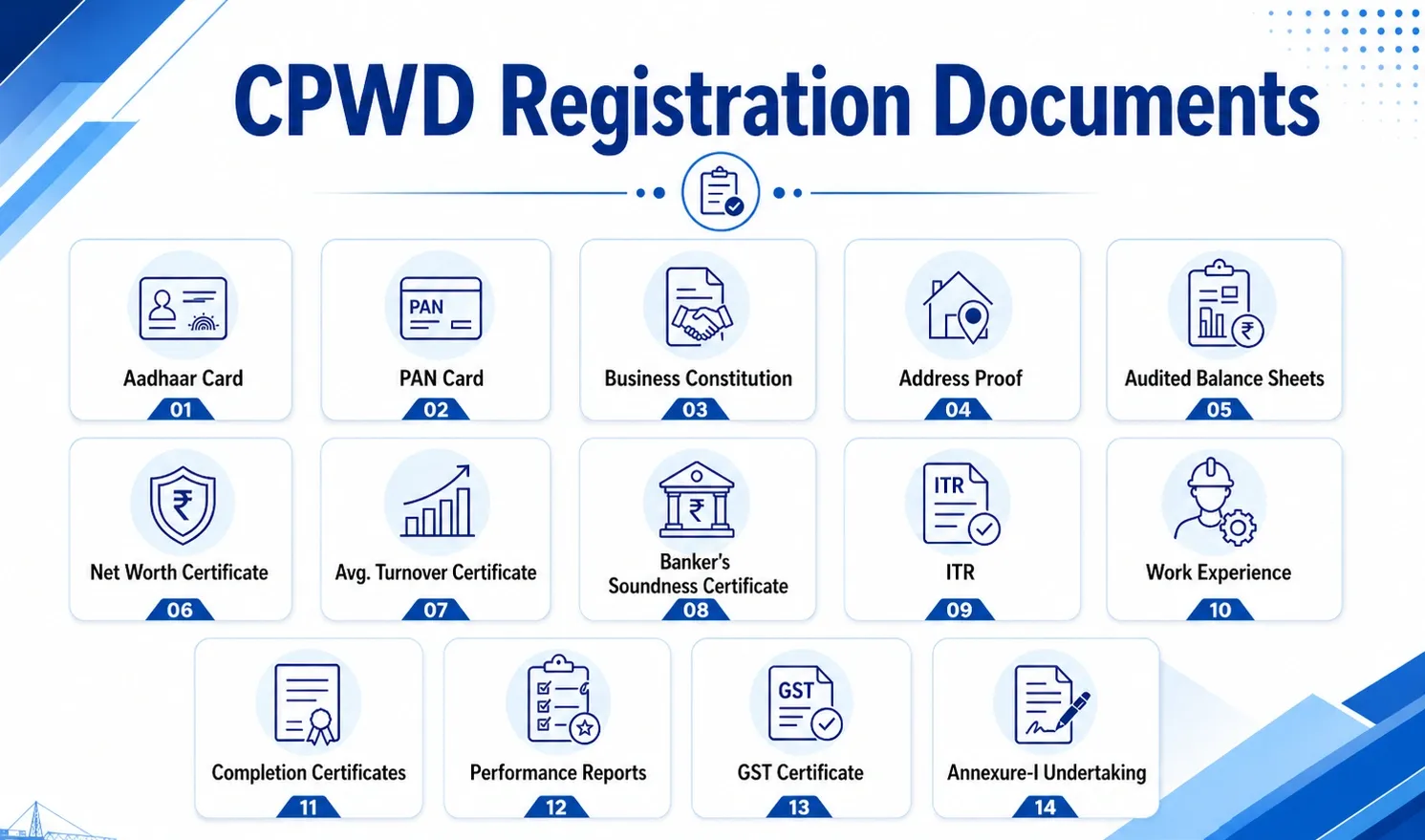
CPWD registration documents: Prepare these documents before starting your application. Incomplete documents are the most common reason for rejection or delays.
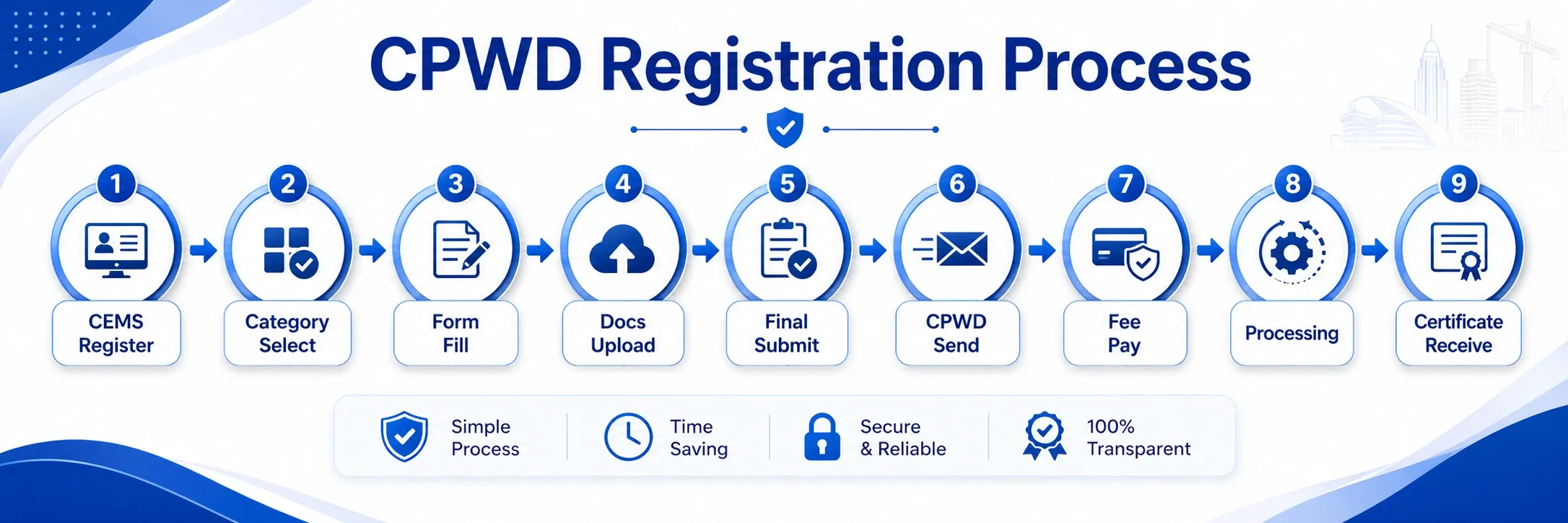
Here a 10 step easy CPWD registration process India. Make sure that you follow all the steps carefully for successful registration.
Step 1: Check Eligibility — Decide which category (B&R or Horticulture) and class suits your experience and financial capacity. Use the class table above.
Step 2: Prepare Documents — Gather all technical, financial, statutory, and identity documents as per the checklist for your class.
Step 3: Get a DSC — Obtain a valid Class 3 Digital Signature Certificate. Required for online registration and e-tender participation.
Step 4: Register on CEMS Portal: Visit cpwd.gov.in → Contractors → Contractor Enlistment Management System. Click 'Register'. Enter name as per GST registration, mobile number, email ID, and PAN (PAN becomes your login ID). Complete the captcha and submit. The password is sent to your registered mobile and email
Step 5: Log in and select category/class: Log in using PAN as login ID. Select your application type: Buildings & Roads or Horticulture. Choose the class based on your experience and financial capability
Step 6: Fill the online application form: Complete all sections — entity details, technical staff, work experience (using Annexure-III format), financial details, and compliance declarations. Ensure all information matches your documents exactly
Step 7: Upload all documents: Upload scanned copies of all identity, financial, technical, and compliance documents as required for your class. File formats and size limits are specified on the CEMS portal
Step 8: Submit application as FINAL: Review the application thoroughly. Once submitted as FINAL, major changes cannot be made. Take a printout of the submitted application from the 'Printout of Application' menu option
Step 9: Send physical copies to CPWD: Sign the printed application and send it along with all supporting documents in original to: Contractors Enlistment Section, CPWD, Room Number 332, A-Wing, Nirman Bhawan, New Delhi
Step 10: Fee payment via BharatKosh: Pay the enlistment fee through BharatKosh (the government payment gateway). Payment confirmation is required before your application is processed
Step 11: Application processing: CPWD's Enlistment Section processes your application after physical documents are received and verified. The standard processing timeline is 15–30 working days for complete applications
Step 12: Receive enlistment certificate: Upon successful verification, CPWD issues an enlistment certificate — enabling you to participate in CPWD tenders up to your class's tendering limit For more details, make sure to go through CPWD Contractor Registration Online: Step-by-Step Guide (2026 Update).
Applications already registered under any CPWD regulation (ERP/CEMS) do not need to re-register existing login credentials. The CEMS portal is a National Single Window System that manages the full contractor lifecycle from enlistment to revalidation.
CPWD contractor enlistment Fees 2026 are paid via BharatKosh — the Government of India's online payment gateway. Fee amounts are class and category-specific under the 2026 Rules.
| Class (B&R) | Enlistment Fee (Approx.) | Banker's Certificate (General) | SC/ST Concession |
| Class V | Rs. 5,000 | As per the 2026 Rules | Rs. 4 lakh Banker's Certificate |
| Class IV | Rs. 10,000 | As per the 2026 Rules | Concessional amount |
| Class III | Rs. 15,000 | As per the 2026 Rules | Concessional amount |
| Class II | Rs. 25,000 | As per the 2026 Rules | As per the 2026 Rules |
| Class I and above | Rs. 50,000+ | As per the 2026 Rules | As per the 2026 Rules |
Note: Exact fee amounts under the 2026 Rules should be confirmed on the CEMS portal (cpwd.gov.in) or the current CPWD Enlistment Circular before payment, as these are revised periodically.
Important: SC/ST contractors receive concessional Banker's Certificate amounts. Class V B&R is Rs. 4 lakh, Class IV Horticulture is Rs. 4 lakh (as explicitly stated in Rule 6.6 of the CPWD Enlistment Rules 2026). Ensure you claim the correct concession during the application.
Under the CPWD Enlistment Rules 2026 (Rule 8):
Validity: 5 years from the date of enlistment
Renewal: Applied through CEMS portal before or at the time of expiry
Upgradation: Contractors can apply for upgradation to a higher class once they meet the work experience and financial criteria of the next class
The License Hub assists clients in assessing readiness for upgradation and preparing the complete documentation package
A CPWD Licence is not just a registration — it is your entry pass to India's largest government construction pipeline. With the updated Enlistment Rules 2026 making the process fully digital and class-based, the opportunity is more structured and transparent than ever before.
But the process has real complexity — class selection, non-refundable fees, physical document submission, and strict eligibility checks all mean that preparation matters enormously.
The License Hub has been helping contractors navigate this process with confidence. Whether you are applying for the first time or renewing under the new 2026 rules, our team handles everything from start to finish. Contact us at 9315167991 or thelicensehubs@gmail.com — and take the first step toward your CPWD enlistment today.
A CPWD Licence (officially called enlistment) is issued by the Central Public Works Department to qualify contractors for government construction tenders. Any contractor, firm, or company that wants to bid for CPWD projects must be enlisted. Without it, you cannot participate in any CPWD tender.
The 2026 rules (ER-2026), effective 1 January 2026, introduced Class I (Super) with a ₹650 crore tendering limit, a direct entry path for unemployed engineers and retired government professionals, mandatory GST and ITR uploads on CEMS, and formal repeal of all previous enlistment rules. Fee payment now goes exclusively through BharatKosh.
Standard processing time is 15–30 working days for complete applications after physical documents are received at Nirman Bhawan. Incomplete applications or discrepancies in documents will extend this timeline. Working with The License Hub significantly reduces delays by ensuring your application is complete and correct from day one.
No. The enlistment fee paid via BharatKosh is non-refundable in all cases — including withdrawal, rejection, or reapplication. This is why it is critical to verify your eligibility and prepare complete documents before making the payment.
Yes. The License Hub manages the entire process — eligibility check, document preparation, CEMS filing, BharatKosh payment, physical document dispatch, and follow-up with CPWD. Our team includes retired government officers, chartered accountants, and legal experts with over 30 years of combined experience. Call 9315167991 or email thelicensehubs@gmail.com to get started.
