The License Hub helps you get your electrical contractor license fast. We simplify the process to ensure you meet all requirements & start your business with us.

Google Reviews
4.9 ★★★★★

Being the world’s 4th largest democracy and largest market due to our 1.4 billion population. The world is looking at India as a manufacturing hub. Our government is promoting significant investment in the automotive, electronic, and renewable energy sectors.
Thus, all these initiatives are rapidly changing India’s landscape in the construction and infrastructure sector, where the electrical system forms the backbone of modern buildings, urban development, from wiring for residential buildings to ensuring safety compliance in commercial projects to maintaining high-voltage setups in factories. The electrical contractor license plays a pivotal role.
Also, to ensure all the legal and safety parameters are followed, under Rule 45 of The Indian Electricity Rules, 1956 and The Electricity Act, 2003, IT IS mandatory that an electrical installation work must be carried out by licensed contractors only.
An Electrical contractor license in India not only ensures compliance with electrical safety standards, codes, and regulations to protect public safety but also allows only qualified and verified personnel to handle electrical installations.
Here’s in this blog, we’ll discuss in detail the types, eligibility criteria, along with guidelines for the application process, and renewal rules.
The classification may vary slightly between states (e.g., Rajasthan, Maharashtra, Karnataka, Delhi, Haryana, etc.)
Read More: Types of Electrical Contractor License in India
Eligibility under the Electrical Contractor license not only ensures that the entity gets a license, but also, by following strict criteria and regulations set by the state licensing authorities during the application process, ensures better and secure public safety measures which align with the Bureau of Indian Standards (BIS) and CIA guidelines.
Unemployed electrical engineers with degrees can apply directly, but must demonstrate supervised experience.
Age limit: Up to 65 years for renewals. For partnerships, all partners must meet individual criteria. SC/ST and Women entrepreneur applicants may get fee relaxations in some states.
Prepare the following documents (scanned copies for online application):
1. PAN Card & Aadhaar Card
2. Passport-size photographs
3. Bank solvency certificate or financial statement
4. Educational qualification certificates (ITI/Diploma/Degree)
5. Experience certificate (attested by a licensed contractor)
6. Proof of business registration (if firm/company)
7. Competency certificate (for supervisor/wireman)
8. Proof of office/workshop (rental agreement or property papers)
9. List of tools and safety equipment
10. Demand draft or online payment receipt of the application fee
Step 1. Get the Application Form
Obtain the prescribed form from the relevant licensing authority (state electrical inspectorate, power department, or CEIG / state electrical board).
In many states, this is available for download (or at their office). E.g., Delhi’s Labour Department has “Application Form A for Grant of Electrical Contractor’s License.” labour.delhi.gov.in . or in Rajasthan download the application form (FORM-B) from eid.rajasthan.gov.in
Some states have “Form D” or “Annexures/forms” specified for a contractor license.
Step 2. Fill the Form & Prepare Documents
Fill all required details (personal, business, technical, experience, instruments, staff, etc.), and attach required documents such as:
Step 3. Pay the Application / Examination Fee
Pay via government treasury/challan to the designated head of account. For example, Tripura uses a treasury challan for the application/examination fee. power.tripura.gov.in
Attach the original challan/fee receipt to the application.
Step 4. Submit the Application
Go physically to the office of the state electrical inspector or licensing board/power department. Submit the form with documents and fees.
Step 5. Document Verification & Inspection
The authority verifies your documents.In some cases, they may inspect your office, instruments, work records, etc.
Step 6. Granting of License
If everything is in order, they issue the license (with validity, say 3 or 5 years). You may have to collect it in person or get it delivered, depending on local rules.
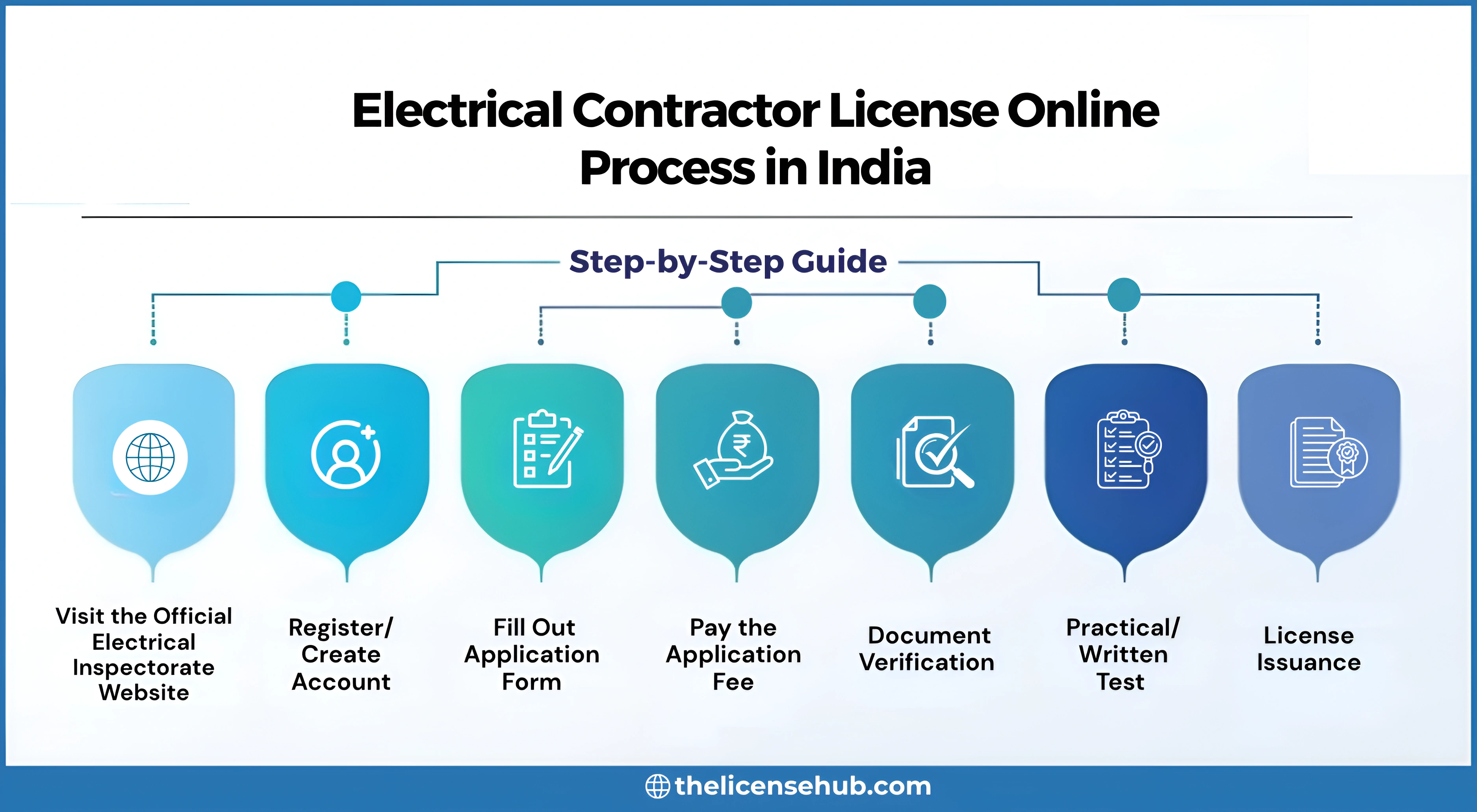
Step 1: Visit the Official Electrical Inspectorate Website
Go to your State Electrical Inspectorate/Energy Department portal or the central government’s website/portal (e.g., power department/electrical licensing authority/CEIG/state inspectorate portal).
Examples:
Step 2: Register/Create Account
Register as a new user under “Electrical Contractor License Application”. Verify your mobile or email with OTP.
Step 3: Fill Out Application Form
Enter personal, educational, and professional details. Select license type (Class A/B/C/D) and upload all required documents.
Step 4: Pay the Application Fee
Pay online through the portal (varies ₹500–₹10,000 depending on license type).
Step 5: Document Verification
Authorities verify the submitted documents and may call you for an interview or inspection.
Step 6: Practical/Written Test (if applicable)
Some states require applicants to pass a technical competency test on wiring, safety, and regulatory knowledge.
Step 7: License Issuance
Once verified and approved, the Electrical Contractor License is issued. The License is valid for 1–5 years and can be renewed after expiry.
Apply for renewal before the expiry date. Submit updated documents and the renewal fee. Renewal is usually quicker than the initial registration.
We, The License Hub , are India's leading experts in licensing and certification, dedicated to simplifying complex regulatory processes for businesses across the nation. With over 9 years of experience, we empower entrepreneurs and organisations to achieve compliance and unlock new opportunities by securing essential government licenses and certifications.
Thus, on behalf of you, we at License Hub, with our team of highly qualified professionals offering incomparable mastery and connections, ensure a smooth and hassle-free experience, along with the best quality service. We navigate the contractor licensing process to enable you, as contractors or construction companies, to bid on government projects — ensuring 100% privacy and data security.
Answer: Licenses are typically categorised into classes based on voltage levels and project scale: Class A (high-tension/HT up to extra-high voltage, unlimited projects), Class B (medium/low voltage up to 33kV or 650V), Class C (low voltage up to 250-650V), and sometimes Class D (basic house wiring up to 650V).
Answer:Yes, contractors must employ at least one licensed Electrical Supervisor (Class A/B competency certificate) and trained wiremen/electricians.
Answer: Fees vary by state: ₹1,000-₹12,000 initially (e.g., ₹ 9,500 for A class and ₹ 850 for D class in Rajasthan, whereas Uttar Pradesh charges ₹ 2500 for any class). Along with renewal and processing fees.
Answer: Yes, individuals (proprietors) or legal entities (partnerships/private firms) can apply. Whereas firms need an office in the state, 3+ trained electricians, GST/PAN, and a bank account.
Answer: Yes, for supervisors (Class A/B competency via board exam); contractors submit experience proofs. Some states (e.g., UP) require contractor verification/exam post-application.
Answer: Contact the state CEIG office (e.g., UP: vidyutsurakshaup.org; Karnataka: ksei.gov.in) or consultants like The License Hub. Free initial queries via portals; paid services for document prep.
