 Admin
Admin
 12-05-2026
 CPWD Contractor
Getting CPWD registration is an important step for contractors who want to work on government construction, road, building, maintenance, or horticulture projects in India. CPWD registration, also known as contractor enlistment, allows eligible contractors to participate in CPWD tenders based on their class, category, financial capacity, and work experience.
But many contractors face rejection because they submit the application without fully understanding the CPWD contractor enlistment rules, document requirements, financial eligibility, and CEMS portal process. Even a small mistake in the application, Annexure, work certificate, GST details, or CA certificate can delay or reject the registration.
In this blog, we will explain the 10 major reasons why CPWD registration gets rejected in India and how contractors can avoid these mistakes before applying.
CPWD registration is the process through which contractors get enlisted with the Central Public Works Department for specific categories and classes of work. The official rules state that contractor enlistment helps CPWD maintain a ready list of suitable and competent contractors for CPWD works. However, enlistment only allows contractors to participate in tenders subject to NIT conditions; it does not guarantee work allotment.
Contractors are enlisted mainly under categories such as:
Before applying for the CPWD license online, it is very important to understand the CPWD Contractor Classes and the eligibility criteria.
The official CPWD enlistment rules mention that Buildings & Roads contractors can be enlisted in classes such as I(Super), I(AAA), I(AA), I(A), I, II, III, IV, and V, while Horticulture enlistment has classes I(A), I, II, III, and IV.
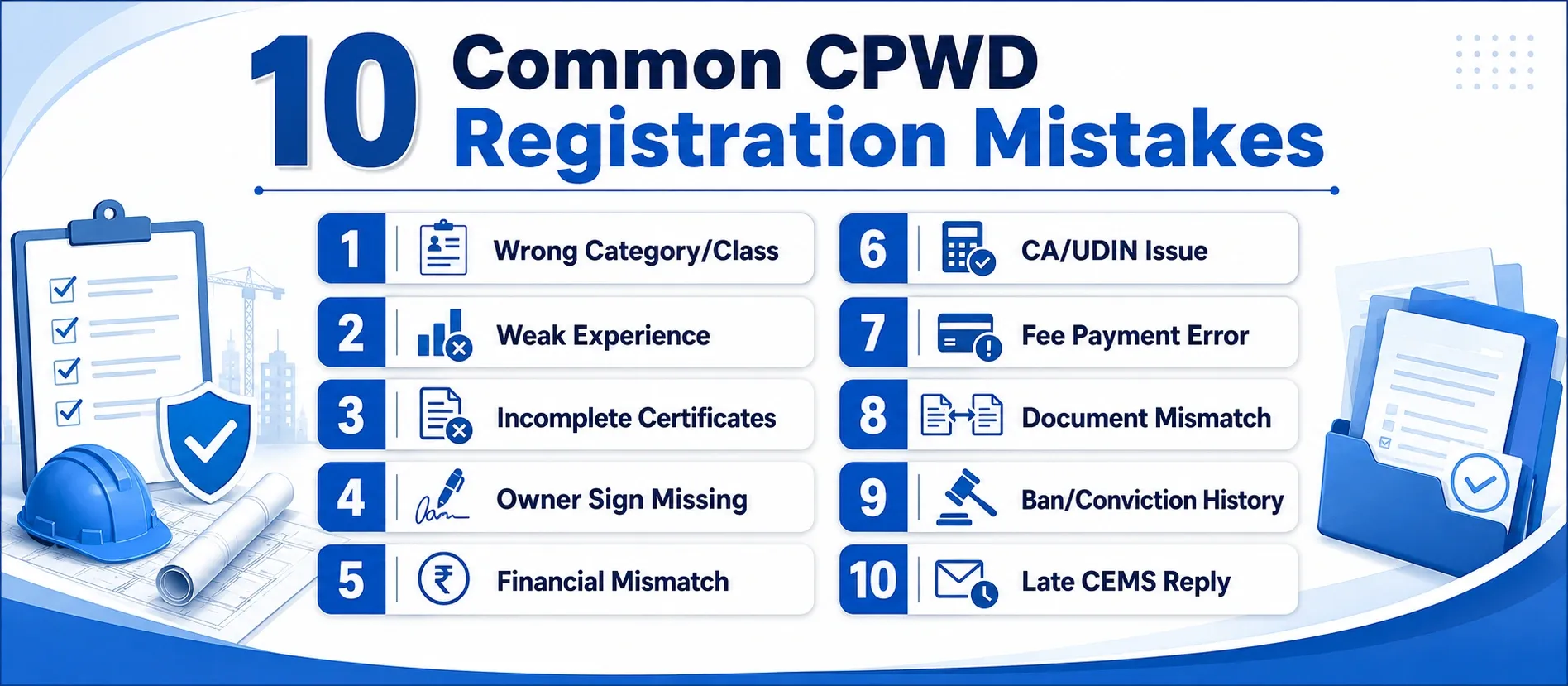
Here are the 10 most common reasons why CPWD registration gets rejected in India:
One of the most common CPWD registration rejection reasons is choosing the wrong category or class. Many contractors apply for a higher class without checking whether their work experience, financial capacity, and documents match the eligibility criteria.
For example, a contractor with horticulture work experience should not apply under the Buildings & Roads category unless they meet the required criteria for that category. Similarly, applying for Class I without having the required work value, turnover, or financial soundness can create rejection risk.
The official rules clearly mention that contractors enlisted in a particular category are not allowed to participate in tenders of other categories.
How to avoid this mistake: Before applying, match your work experience, turnover, net worth, banker’s certificate, and project history with the correct CPWD category and class. Many contractors take help from professional CPWD registration consultants to avoid application mistakes and class sections.
CPWD checks whether your work experience is relevant to the category and class you are applying for. If the completed or ongoing work does not match the prescribed nature, value, period, or type of work, the application may get rejected.
The rules mention that work experience should be of the prescribed nature and magnitude, executed on an independent contract basis during the last five years. The work should generally be executed in the same name and style in which enlistment is being sought.
Common work experience issues include:
How to avoid this mistake: Use only eligible, relevant, and verifiable work experience certificates. Make sure the work matches the CPWD class and category requirements.
Many contractors have completed projects but still face rejection because their work completion certificates are incomplete or not properly verified. CPWD may reject or object to certificates that do not clearly show the work name, value, date, owner details, completion status, quality grading, or signature.
The rules also mention that work which cannot be inspected later for quality parameters may be accepted only if the completion certificate is issued by the owner department with grading for quality of work.
Common certificate mistakes include:
How to avoid this mistake: Before uploading, check whether every certificate has proper details, seal, signature, project value, date, and owner department verification.
Annexure-III is one of the most important documents in CPWD contractor registration. It contains the details of eligible works submitted for experience verification. If Annexure-III is not properly signed by the owner department, the application can be rejected.
The official rules specifically state that applications received without Annexure-III signed by the owner, or filled with incomplete information, may be rejected. The Annexure notes also mention that Annexure-III without a valid signature of the owner department is invalid.
Common Annexure-III mistakes include:
How to avoid this mistake: Get Annexure-III signed and sealed by the correct owner department. If the work is under a back-to-back contract, ensure required certification from the owner and first agency as applicable.
CPWD registration is not based only on work experience. Financial soundness is also important. If the applicant does not meet the required financial criteria for the selected class, the registration may be rejected.
Depending on the class and category, CPWD may check documents such as:
The rules include financial soundness requirements and mention that net worth and annual turnover certificates are verified by CPWD officers through the UDIN website.
How to avoid this mistake: Do not apply for a higher class just for better tendering limits. Apply for the class where your financial documents clearly meet the eligibility criteria.
A common reason for CPWD enlistment rejection is incorrect CA certification. Many contractors upload turnover or net worth certificates, but the documents are not in the prescribed Annexure format or are not updated on the UDIN portal.
The official rules mention that Annexure V2 and V3 should be in the prescribed format and must be updated on the UDIN portal; otherwise, the application can be rejected after the allowed correction opportunity.
Common CA certificate mistakes include:
How to avoid this mistake: Ask your CA to prepare certificates strictly in the CPWD-prescribed format and verify the UDIN before uploading.
The enlistment fee is mandatory for CPWD registration. If the fee is not paid correctly or the receipt is not uploaded, the application may be processed for rejection.
The official rules state that the applicant has to pay the prescribed enlistment fee online and upload the application along with the system-generated electronic receipt on the CEMS portal. The rules also mention that the enlistment fee is non-refundable, so applicants should ensure eligibility before making payment.
Common fee-related mistakes include:
How to avoid this mistake: Check the applicable fee for your selected category and class before payment. Upload the correct payment receipt with the application.
Basic identity and business documents must be correct and consistent. CPWD may raise objections if the applicant’s PAN, Aadhaar, GST, business name, address, incorporation details, or partnership documents do not match.
The official rules mention that individuals, proprietors, partners, and directors must have valid Aadhaar and PAN cards. Contractors also need to ensure business/entity documents are properly registered with the competent authority where applicable.
Common document mismatch issues include:
How to avoid this mistake: Before submitting the CPWD registration application, match all names, addresses, PAN, GST, Aadhaar, entity documents, and signatures.
CPWD registration can also be rejected if the applicant, partner, director, firm, or company has a disciplinary or legal disqualification.
The official rules state that an individual, firm, LLP, private limited company, or public limited company may not be entitled for enlistment if the concerned person is a dismissed government servant, debarred from enlistment, banned by a government department or PSU, or convicted by a court of law.
This can include:
How to avoid this mistake: Review the legal and disciplinary status of the applicant entity, partners, and directors before applying.
CPWD may ask for clarification or corrected documents through the CEMS portal. If the applicant does not respond within the given time, the application can be rejected.
The rules mention that applicants are given one opportunity to clarify and correct shortcomings through the portal. If there is no response or an incomplete response within 15 days of the clarification letter, the application may be rejected without further opportunity.
Common CEMS mistakes include:
How to avoid this mistake: Check the CEMS portal regularly after submission. Respond to any clarification quickly and upload corrected documents within the given timeline.
| Rejection Reason | How to Avoid It |
| Wrong category or class | Match eligibility with CPWD class and category |
| Insufficient work experience | Submit only eligible and relevant work certificates |
| Incomplete completion certificate | Ensure seal, signature, value, date, and work details |
| Annexure-III not signed | Get valid owner department signature and seal |
| Financial eligibility gap | Apply for a class that matches your financial capacity |
| Invalid CA certificates | Use the prescribed format and UDIN verification |
| Missing enlistment fee | Pay correct fee and upload receipt |
| PAN/GST/Aadhaar mismatch | Keep all identity and business details consistent |
| Debarment or ban history | Check legal eligibility before applying |
| No CEMS response | Reply to clarification within 15 days |
CPWD registration rejection are mostly because of avoidable mistakes. Wrong class selection, incomplete Annexures, invalid work certificates, financial document errors, missing fee payment, UDIN issues, and delayed CEMS responses are some of the most common reasons.
Before applying, review every document carefully and make sure your application follows the official CPWD enlistment requirements.
CPWD registration can get rejected due to missing documents, wrong class selection, incomplete Annexure-III, unpaid enlistment fee, invalid CA certificates, insufficient work experience, PAN/GST mismatch, or no response to CEMS clarification within the given time.
Yes, Annexure-III is very important because it contains details of eligible work experience. If Annexure-III is not signed by the owner department or contains incomplete details, the application may be rejected.
Yes, wrong or unverifiable UDIN details can create rejection risk. CPWD rules mention that CA certificates such as turnover and net worth certificates should be verifiable through the UDIN portal.
If CPWD asks for clarification through the CEMS portal and the applicant does not respond or gives an incomplete response within 15 days, the application may be rejected without further opportunity.
No, the official rules mention that the enlistment fee is non-refundable. Contractors should check eligibility carefully before applying and making payment.
Yes, contractors may apply again after correcting the reasons for rejection. However, the previous enlistment fee may not be refunded, so it is better to submit a complete and correct application the first time.
Commonly checked documents include PAN, Aadhaar, GST, entity documents, work completion certificates, Annexure-III, Banker’s Certificate, Net Worth Certificate, Average Annual Turnover Certificate, UDIN details, and fee receipt.
To avoid rejection, choose the correct category and class, submit complete work certificates, use prescribed Annexure formats, verify UDIN, pay the correct fee, keep PAN/GST details consistent, and respond to CEMS portal clarification on time.
