.webp "How to Get an Electrical Contractor License in Karnataka Step-by-Step Guide (2026)")
 Admin
Admin
 12-09-2026
 Electrical Contractor License
If you install, maintain, or supervise electrical wiring anywhere in Karnataka - from a Bengaluru apartment complex to a factory in Hubballi - you need an Electrical Contractor License issued by the state's Electrical Inspectorate before you can legally take up the work. Without it, you can't sign off on installations, bid for government electrical tenders, or get your work certified by the licensee (BESCOM, MESCOM, HESCOM, and so on).
Quick answer: In Karnataka, electrical contractor licenses are granted under the Karnataka (Licensing of Electrical Contractors, Special Wiring Permit and Grant of Certificates and Permits to Electrical Supervisors and Wiremen) Rules, 2012 (amended in 2025), through the Karnataka State Electrical Inspectorate (KSEI). You apply online via the Seva Sindhu portal, submit proof of a qualified Supervisor and Wireman on staff, testing instruments, a bank solvency certificate, and the prescribed fee - after which the Chief Electrical Inspector to Government (CEIG) verifies your application and issues the license for the class you qualify for.
This guide walks through the license classes, who is eligible, the documents you need, and the exact application steps - offline and online - so you can plan your application without guesswork.
An Electrical Contractor License authorizes an individual or firm to carry out electrical installation, wiring, testing, and maintenance work as a business within Karnataka. It's issued by the Department of Electrical Inspectorate, Government of Karnataka, under the authority of the CEIG.
The requirement traces back to Rule 45 of the Indian Electricity Rules and Section 180 of the Electricity Act, 2003, which empower state governments to frame their own licensing rules for electrical contractors, supervisors, and wiremen. Karnataka's version of these rules - notified in 2012 and updated through amendments, including one in January 2025 - sets out the classes, eligibility, and procedure that apply specifically within the state.
In short: if your business plans to sign electrical completion certificates, apply for power connections on behalf of clients, or take up contract wiring work, you (or your firm) must hold a valid license in the appropriate class before starting.
You need a Karnataka Electrical Contractor License if you:
If you're only ever going to work as an employee under a licensed contractor, you'd typically hold a Supervisor or Wireman permit instead, not the contractor's license itself.
Unlike some states that use an A/B/C/D naming convention (you can compare that structure in our guide to different types of electrical licenses and their eligibility criteria), Karnataka classifies electrical contractor licenses into four categories based on voltage and scale of work.
| Class | Scope of Work | Typical Applicant |
| Super Grade | All electrical work, low voltage to extra-high voltage (EHV), with no restriction | Established firms handling large industrial/HT projects |
| Class-1 | Electrical installation work up to 33 kV | Mid-to-large contractors with prior Class-2 experience |
| Class-2 | Electrical work up to 650V | Contractors serving commercial/light industrial clients |
| Class-3 | Electrical work up to 250V (low voltage) | Small contractors handling residential/basic wiring |
Each higher class generally requires a track record at the class below it, along with a larger technical team, stronger financial solvency, and more testing equipment.
Because the 2025 amendment revised parts of the 2012 rules, treat exact experience durations, staffing numbers, and solvency amounts as indicative - always cross-check the current figures on the KSEI or Seva Sindhu portal, or with a licensing consultant, before you apply.
Keep scanned and physical copies of the following ready:
1. Duly filled application form (Form A, as prescribed under Rule 12)
2. Photo identity proof (Aadhaar, PAN, voter ID, etc.)
3. Proof of age and educational qualification (SSLC certificate or higher)
4. Passport-size photographs, self-attested and attested by a jurisdictional Electrical Inspectorate officer
5. Bank solvency certificate on Form B or C
6. Valid Electrical Supervisor and Wireman permits (your own, or your employees')
7. Proof of business premises (ownership or lease document)
8. List and calibration proof of testing instruments and safety equipment
9. Experience certificates for higher-class applications (Class-1 and Super Grade)
10. Proof of EPF/ESI registration for staff, where applicable
11. Notarized declarations/affidavits as specified in the application form
12. Application/processing fee payment receipt or challan
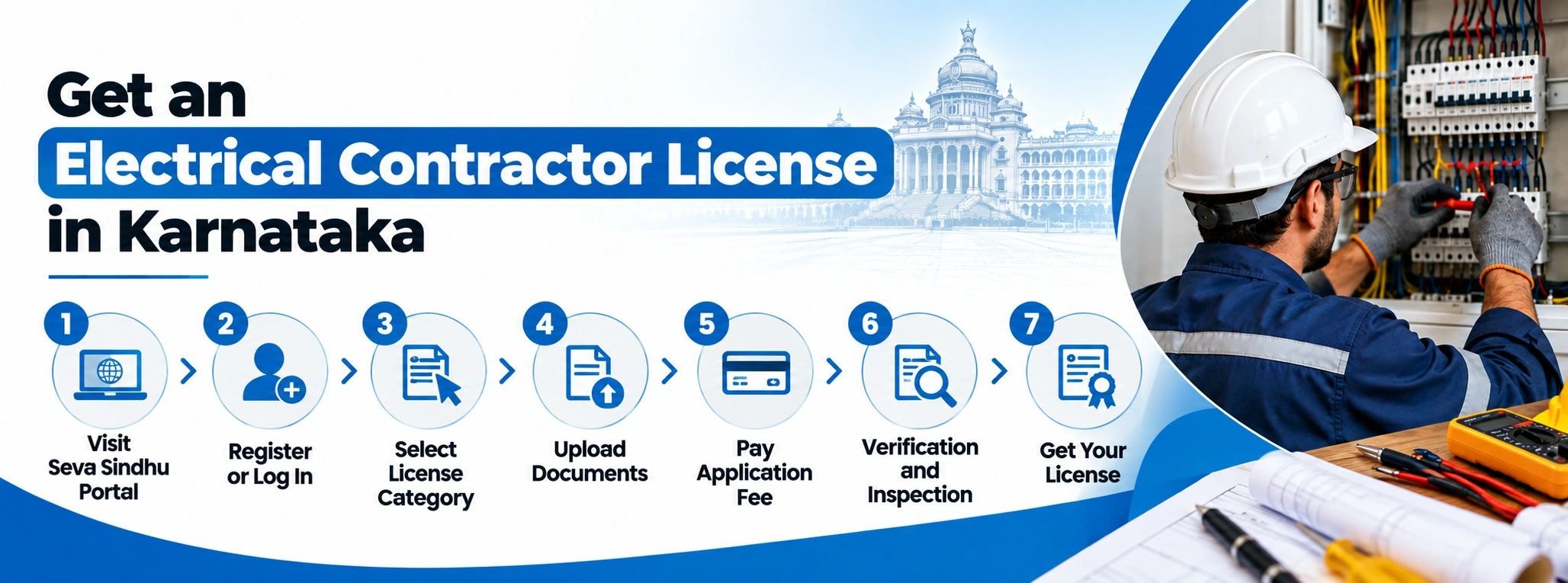
Since September 2021, all electrical licensing services in Karnataka - including new contractor licenses, renewals, and supervisor/wireman permits - are processed through the Seva Sindhu portal rather than the older KSEI eiSoft system.
Step 1: Visit the Seva Sindhu Portal: Go to sevasindhu.karnataka.gov.in and locate the Department of Electrical Inspectorate services, or search for "Application for Enrollment of Contractors."
Step 2: Register or Log In: Create an account using your mobile number or Aadhaar-linked credentials, and verify via OTP.
Step 3: Select the License Category: Choose the class you're applying for (Super Grade, Class-1, Class-2, or Class-3) and fill in your personal, business, and technical details.
Step 4: Upload Documents: Attach scanned copies of all documents listed above - identity proof, qualification certificates, supervisor/wireman permits, solvency certificate, and instrument lists.
Step 5: Pay the Application Fee: Pay the prescribed fee online through the portal. Fees vary by class and are periodically revised, so confirm the current amount at the time of application.
Step 6: Verification and Inspection: The jurisdictional Electrical Inspectorate office verifies your documents and may inspect your office, staff credentials, and equipment before recommending approval.
Step 7: License Issuance: Once the CEIG's office approves the application, your license is issued and can typically be downloaded or collected as intimated on the portal.
If you'd rather apply in person, or if your local office still accepts physical filings:
1. Download Form A from the KSEI website or collect it from the jurisdictional Electrical Inspectorate office.
2. Fill in the form and attach all required documents and the fee challan.
3. Submit the physical application at the office of the Electrical Inspector for your district, or at the CEIG's office in Bengaluru for Super Grade/Class-1 applications.
4. The department verifies your documents and, where needed, inspects your premises and instruments.
5. On approval, the license is issued in book form as prescribed under the rules.
For a broader look at how offline and online processes typically differ across departments, see our guide on how to get different contractor licenses in India.
Application and processing fees in Karnataka are set out in government orders and revised periodically by the Department of Energy - they differ by class, with Super Grade and Class-1 carrying higher fees than Class-2 and Class-3. Rather than quoting figures that may be outdated by the time you apply, check the current fee schedule directly on the Seva Sindhu portal or confirm with the Electrical Inspectorate office before submitting your payment.
On validity: electrical contractor licenses in Karnataka are typically issued for an initial term and can be renewed for a longer block once you have an established track record - but exact validity periods have been adjusted in past rule amendments, so verify the current term that applies to your class at the time of issue. To renew, you'll generally need to apply before expiry with an updated staff list, current permits, tax receipts, and the renewal fee; letting a license lapse beyond the permitted grace period usually means reapplying as a fresh application.
Based on patterns seen across state electrical licensing processes, applications commonly run into trouble because of:
Getting these right the first time saves weeks of back-and-forth with the department. If you'd like a sense of how licensing gaps translate into real business risk, our post on why electrical licensing matters and helps avoid penalties covers the compliance side in more depth.
Karnataka's licensing process involves multiple moving parts - supervisor and wireman permits, solvency certificates, instrument documentation, and inspection scheduling - and a single missing document can push your application back by weeks.
At The License Hub, we help contractors and firms across India prepare and file electrical contractor license applications correctly the first time. Our team reviews your eligibility against the class you're targeting, organizes your documentation, manages the Seva Sindhu filing, and follows up with the Electrical Inspectorate office on your behalf - so you can focus on running your business while we handle the paperwork.
If you're setting up operations in more than one state, we also assist with electrical contractor licensing in Uttar Pradesh, Delhi, and Bihar, among other states.
Getting an electrical contractor license in Karnataka is straightforward once you know which class fits your business and have your documentation - supervisor/wireman permits, solvency certificate, and instrument records - in order before you file. The Seva Sindhu portal has simplified the filing, but you still need to meet eligibility and inspection requirements precisely, since even small mismatches can stall your application.
If you'd rather not navigate the paperwork alone, The License Hub's electrical contractor licensing team can guide you through eligibility checks, documentation, and filing - end to end. Get in touch for a free consultation to get started.
The Karnataka State Electrical Inspectorate (KSEI), under the Chief Electrical Inspector to Government (CEIG), Department of Energy, issues and regulates electrical contractor licenses in the state.
For Class-3, entry-level requirements are lower and geared toward new contractors. Higher classes like Class-1 and Super Grade require a documented track record at the class below, so you generally need to build experience before moving up.
No. Electrical contractor licenses are issued and regulated separately by each state under its own rules. A Karnataka license does not automatically authorize you to work in another state.
You can hold the relevant Supervisor and Wireman permits yourself if you're individually qualified, or employ people who hold valid permits - either way, a permit holder must be on record for your license to be granted.
Karnataka uses Super Grade, Class-1, Class-2, and Class-3 based on voltage limits, whereas several other states use an A/B/C/D structure. The underlying idea - scaling eligibility and scope of work with license class - is similar; only the naming and specific thresholds differ. See our comparison in Types of Electrical Licenses & Their Eligibility Criteria.
You can apply directly through the Seva Sindhu portal, or work with a licensing consultant like The License Hub to manage document preparation, filing, and follow-up.
