 Admin
Admin
 26-05-2026
 CPWD Contractor
Staying updated with CPWD enlistment rules 2026 is important for every contractor who wants to work on government projects without confusion or rejection. Whether you are planning your first CPWD contractor registration, looking for complete guidance on CPWD Registration, or checking the latest eligibility and document requirements, one small mistake can delay the whole process. That is why this blog is designed to give you a clear, practical understanding of the rules in one place.
In this guide, you will learn about CPWD enlistment eligibility, required documents, contractor categories, class structure, and the step-by-step enlistment process. We will also cover key CPWD enlistment updates and explain what contractors should know before applying under the latest framework. If you want a simple and useful explanation of the process, this blog will help you start with clarity and avoid common mistakes.
A CPWD contractor license — officially called enlistment — is a registration certificate issued by the Central Public Works Department that qualifies a contractor to bid for and execute government construction works. It is not a generic business licence — it is a specific enlistment on CPWD's approved contractor list.
CPWD is India's premier engineering and construction organisation, functioning under the Ministry of Housing and Urban Affairs (MoHUA). Established in 1854, it is responsible for planning, construction, and maintenance of all central government infrastructure — buildings, roads, offices, and horticulture works — across the country.
Without CPWD enlistment, a contractor cannot bid for any CPWD tender. Enlistment removes the need for repeated pre-qualification at every individual tender — saving time and enabling consistent access to government work. It signals technical and financial credibility to all government departments that accept CPWD-registered contractors.
According to revised rules of CPWD Enlistment Rules 2026 there are some key changes regarding the eligibility and updated documents:
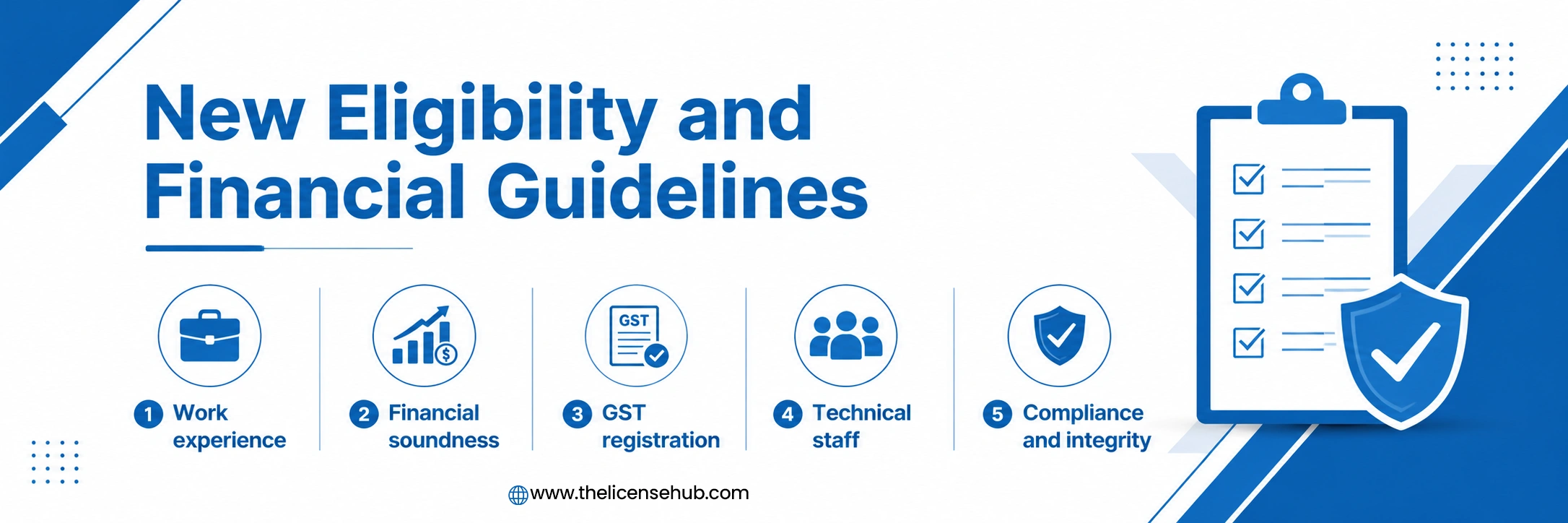
Under the 2026 Rules, eligibility is assessed on:
To apply for CPWD license under the CPWD contractor new guidelines, the applicant must satisfy the following conditions:
Entity types: Indian individual (citizen of India), sole proprietorship, partnership firm, limited liability partnership (LLP), private limited company, or public limited company
Special categories: Unemployed engineers and architects with degree/diploma; retired engineers and officials from Central/State Government Departments and PSUs — all eligible under specific conditions in the 2026 Rules
Before applying for CPWD licenses it is important to understand the contractor categories according to new CPWD enlistment rules of 2026:
Before applying for the CPWD license online, it is very important to understand the Difference Between CPWD Contractor Classes and Eligibility Criteria For contractors engaged in building construction, civil works, and road infrastructure. This category has 8 classes with the following tendering limits (verified against CPWD enlistment rules 2026):
| Class | Tendering Limit (Upper) | Suitable For |
| Class I (Super) | Up to Rs. 650 crore | Mega infrastructure, large government complexes |
| Class I (AAA) | Up to Rs. 100 crore | Very large projects — PSUs and major central govt. works |
| Class I (AA) | Up to Rs. 65 crore | Large-scale building and road projects |
| Class I (A) | Up to Rs. 42 crore | Upper-tier multi-crore construction contracts |
| Class I | Up to Rs. 25 crore | Established mid-to-large contractors |
| Class II | Up to Rs. 15 crore | Mid-level contractors with a strong track record |
| Class III | Up to Rs. 4 crore | Regional contractors with moderate experience |
| Class IV | Up to Rs. 1.3 crore | Smaller contractors entering CPWD projects |
| Class V | Up to Rs. 40 lakh | Entry-level contractors, first CPWD project |
For contractors engaged in landscaping, tree planting, nursery work, lawn maintenance, and park development. Classes range from Class I(A) to Class IV, with tendering limits from Rs. 3 crore down to Rs. 20 lakh.
Source: Rules for Enlistment of Contractors in CPWD 2026 — verified against CEMS portal and cpwd.gov.in.
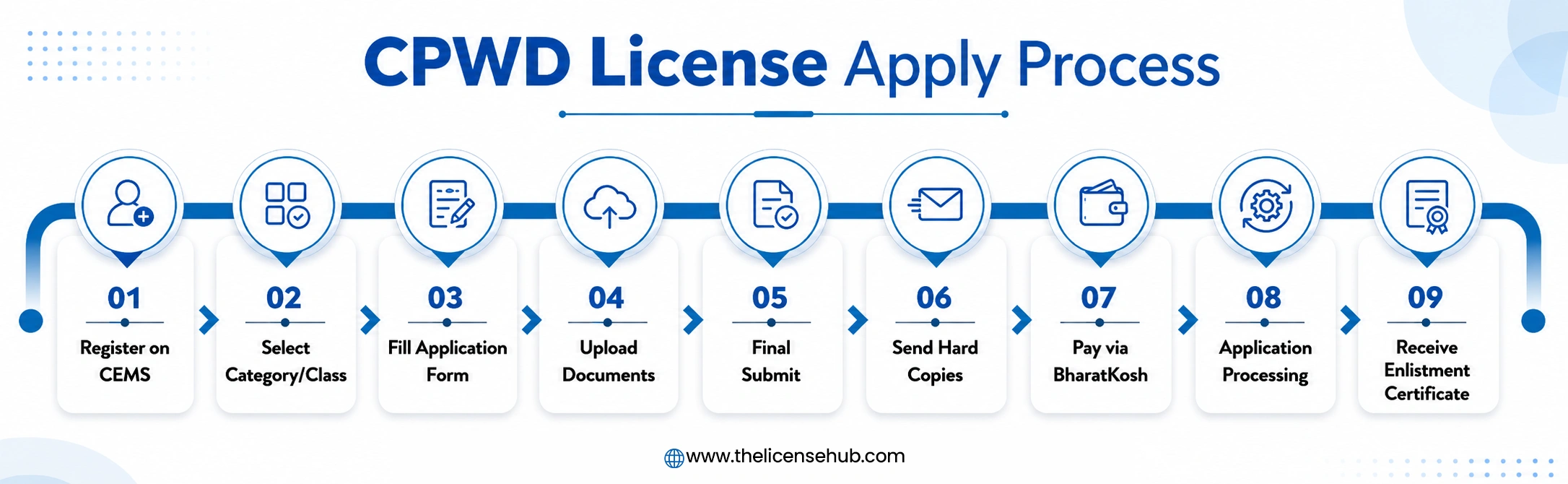
All applications must be filed through the CEMS portal — CPWD's Contractor Enlistment Management System. Here is the verified process:
1. Register on CEMS Portal: Visit cpwd.gov.in → Contractors → Contractor Enlistment Management System. Click 'Register'. Enter name as per GST registration, mobile number, email ID, and PAN (PAN becomes your login ID). Complete captcha and submit. Password is sent to your registered mobile and email
2. Log in and select category/class: Log in using PAN as login ID. Select your application type: Buildings & Roads or Horticulture. Choose the class based on your experience and financial capability
3. Fill the online application form: Complete all sections — entity details, technical staff, work experience (using Annexure-III format), financial details, and compliance declarations. Ensure all information matches your documents exactly
4. Upload all documents: Upload scanned copies of all identity, financial, technical, and compliance documents as required for your class. File formats and size limits are specified on the CEMS portal
5. Submit application as FINAL: Review the application thoroughly. Once submitted as FINAL, major changes cannot be made. Take a printout of the submitted application from the 'Printout of Application' menu option
6. Send physical copies to CPWD: Sign the printed application and send it along with all supporting documents in original to: Contractors Enlistment Section, CPWD, Room Number 332, A-Wing, Nirman Bhawan, New Delhi
7. Fee payment via BharatKosh: Pay the enlistment fee through BharatKosh (the government payment gateway). Payment confirmation is required before your application is processed
8. Application processing: CPWD's Enlistment Section processes your application after physical documents are received and verified. The standard processing timeline is 15–30 working days for complete applications
9. Receive enlistment certificate: Upon successful verification, CPWD issues an enlistment certificate — enabling you to participate in CPWD tenders up to your class's tendering limit.
LicenseHub: Your CPWD Enlistment Partner
LicenseHub has 9+ years of experience helping contractors achieve CPWD enlistment — from eligibility assessment and document preparation to CEMS filing and physical submission coordination. If the process feels complex or if you are unsure which class and category apply to your situation, our team can evaluate your case and manage the entire application on your behalf.
Understanding the CPWD Enlistment Rules 2026 is important for contractors who want to apply with confidence and avoid unnecessary delays. From checking eligibility and choosing the right category to preparing documents and following the correct process, every step plays a key role in successful enlistment. A clear understanding of the latest rules can help contractors reduce errors, improve compliance, and move forward with the application more smoothly. If you are planning to register under CPWD, the best approach is to stay prepared, keep your documents in order, and follow the process carefully from the start.
CPWD enlistment eligibility in 2026 usually depends on factors like contractor category, work experience, financial capacity, technical qualification, and proper business documents.
Documents required for CPWD contractor registration generally include identity proof, business registration documents, work experience certificates, financial statements, affidavits, and other supporting records based on the enlistment category and class applied for.
The CPWD enlistment process usually starts with checking eligibility, selecting the correct category and class, collecting documents, submitting the application online, and completing verification.
If you are applying for CPWD enlistment for the first time, start by checking your eligibility, deciding the right contractor category and class, and preparing all required documents before filling out the application.
A CPWD enlistment application may get delayed because of incomplete documents, incorrect category selection, mismatched financial details, missing certificates, or errors in the submitted application.
