 Admin
Admin
 14-08-2026
 Surety & Financial Guarantees
If you've ever had to furnish a bid security, a performance guarantee, or an advance payment security for a government contract, you've almost certainly dealt with a bank guarantee. It's been the standard instrument in India for decades, required, familiar, and accepted everywhere.
But familiar doesn't mean efficient. And in 2026, contractors and businesses across India are increasingly asking a different question: does this have to be a bank guarantee, or is there a better option?
The answer, since IRDAI began regulating insurance surety bonds in India from January 2022 and the Department of Financial Services issued a landmark circular in September 2024 requiring all central government departments to accept surety bonds, is that there's now a genuine, regulated alternative with real structural advantages.
This guide explains both instruments clearly, compares them directly, and helps you decide which one makes more sense for your specific situation.
A bank guarantee is a two-party instrument issued by a bank on behalf of a customer. The bank promises the beneficiary (usually a project owner or government department) that if the customer fails to meet their contractual obligations, the bank will pay up to the specified guarantee amount.
In practice, the bank issues this guarantee only after securing itself through cash margin (typically 10–25% of the guarantee value) or equivalent collateral in the form of Real estate, property, gold, and other approved assets. This margin gets blocked for the entire duration of the guarantee, and the guarantee also consumes the customer's Non-Fund Based (NFB) credit limit at the bank.
Bank guarantees are called 'unconditional' because the bank pays on demand from the beneficiary, without investigating whether the underlying claim is actually valid. The bank recovers from the margin or collateral it already holds.
Eg: A bank guarantee on a Rs.50 crore contract effectively costs 8–10% once blocked cash margins are included and not the 1–2% annual commission that appears in the headline rate.
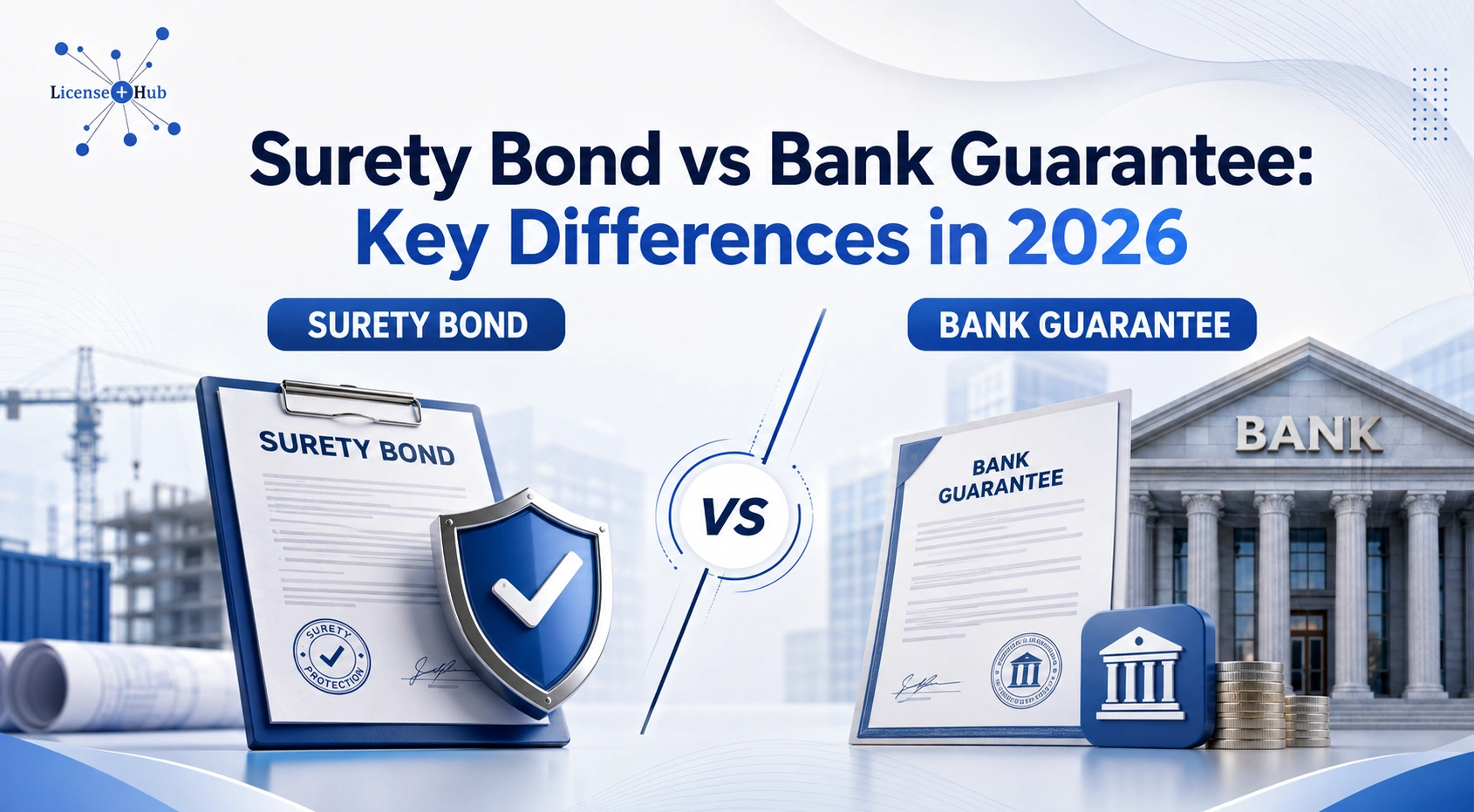
A surety bond is a three-party guarantee issued by an IRDAI-licensed insurance company (the surety). The three parties are:
If the Principal defaults, the Surety pays the Obligee up to the bond amount and then seeks reimbursement from the Principal. Crucially, the surety bond does not consume the contractor's bank credit limit, and typically requires little to no cash margin.
The insurer evaluates the contractor's technical capability, track record, and project-specific risks rather than just credit score and assets. This makes surety bonds accessible to contractors who may have limited bank credit but a strong performance history.
As of 2026, surety bonds are regulated by IRDAI under the IRDAI (Surety Insurance Contracts) Guidelines 2022, and the September 2024 DFS circular now requires all central government departments to accept insurance surety bonds as an alternative to bank guarantees in procurement.
| Parameter | Surety Bond | Bank Guarantee |
| Issued by | IRDAI-licensed insurance company (surety insurer) | Bank or financial institution |
| Parties involved | Three: Principal, Obligee, Surety (insurer) | Two: Applicant (contractor) and Beneficiary |
| Legal nature | Contract of insurance/indemnity | Banking instrument/credit facility |
| Cash margin required | Little to none in most cases | 10–25% cash margin or equivalent collateral |
| Impact on bank credit | Does not consume bank credit limits | Directly reduces Non-Fund Based (NFB) credit limit |
| Typical cost | 0.5–3% premium per annum | Effectively 8–10% when blocked margin is included |
| Risk assessment | Based on performance capability and track record | Based on creditworthiness and asset collateral |
| Working capital impact | Minimal: capital stays in the business | Significant: cash is blocked for the contract duration |
| Default process | Insurer investigates and pays valid claims | Bank pays on demand — usually unconditional |
| Accepted by govt. tenders (India) | Yes, DFS circular September 2024 mandates acceptance | Yes, long-standing practice |
| Recourse after claim | Surety recovers from principal | Bank recovers from margin or collateral in form of Real estate, property or gold already held with them as guarantee. |
The most important thing to understand about comparing these two instruments is that the headline fee is not the real cost.
A bank guarantee charges an annual commission of roughly 1–2% of the guarantee amount. That sounds cheap. But on top of that, the bank blocks 10–25% of the guarantee value as cash margin for the entire duration of the contract. That blocked cash earns nothing, can't be deployed, and effectively increases the real cost of the instrument significantly.
A surety bond charges a premium of 0.5–3% per annum, with little or no cash margin. The premium is the cost; there's no blocked capital sitting idle on the side.
The practical difference on a Rs.50 crore contract lasting two years:
That difference isn't marginal. For a contractor running multiple contracts simultaneously, each one requiring its own bank guarantee, the cumulative capital locked in margin accounts can represent a significant constraint on growth.
Because surety bonds don't block funds, contractors can bid for more work without exhausting their bank credit limits. This is one of the primary reasons NHAI and other infrastructure bodies have been actively encouraging surety bond adoption.
| Bond / Guarantee Type | Purpose | When Required |
| Bid Bond / EMD | Guarantees that the winning bidder will sign the contract and furnish performance security as required by the tender. | Government tenders and competitive procurement processes |
| Performance Bond | Guarantees that the contractor will complete the project as per contract terms and conditions. | Most construction, infrastructure, and EPC contracts |
| Advance Payment Bond | Protects the project owner's mobilisation advance — the upfront funds paid to the contractor for site setup and materials — ensuring repayment if the contractor defaults or fails to perform. | Contracts where advance mobilisation funds are released upfront |
| Retention Money Bond | Allows early release of retention funds against an insurer-backed guarantee | After project completion, before the defect liability period ends |
| Maintenance / Warranty | Covers post-completion defects and warranty obligations | Post-handover defect liability period |
The regulatory framework for surety bonds in India has evolved significantly over the past three years, and the direction of travel is clear.
IRDAI formally allowed licensed general insurers to offer surety bonds in India from April 2022, creating a regulated product class with defined underwriting standards and maximum liability limits.
The Department of Financial Services issued a mandatory circular in September 2024 requiring all central government departments to accept insurance surety bonds as alternatives to bank guarantees in procurement. If a tendering authority is still refusing to accept a surety bond in a central government tender, that circular is the regulatory basis for challenging it.
The National Highways Authority of India has been one of the most active adopters of surety bonds, explicitly permitting insurance surety bonds for bid security, performance security, advance payment security, and mobilisation advance in EPC contracts.
The right instrument depends on your specific situation. Here's a practical framework:
Note: The DFS circular applies to central government departments and PSUs. State government departments, municipal bodies, and private sector clients are not automatically covered verify acceptance in the tender documents before committing to a surety bond.
For most contractors working on government infrastructure projects in India in 2026, surety bonds are worth evaluating seriously, particularly for performance bonds and advance payment bonds where the capital locked in margin accounts is most significant.

Don’t let the wrong financial instrument delay your tender or project. With 10+ years of experience in licensing and certification support, The License Hub helps businesses understand their requirements and choose a suitable route. From document preparation and eligibility checks to application guidance and follow-ups, our experts support you at every step.
Connect with The License Hub today and move forward with greater clarity and confidence.
Surety bonds and bank guarantees serve the same fundamental purpose: providing financial assurance to a beneficiary if the contractor doesn't deliver. But they do it in structurally different ways, at significantly different real costs, and with very different implications for a contractor's working capital and credit position.
If you're evaluating which instrument to use for an upcoming contract or tender, the right answer almost always starts with understanding the total cost and not just the headline rate and whether your bank credit situation makes the capital efficiency of a surety bond genuinely valuable for your business.
No. A surety bond is a three-party insurance contract issued by an IRDAI-licensed insurer, while a bank guarantee is a two-party banking instrument. Both provide financial security to a beneficiary if the contractor defaults, but they differ significantly in structure, cost, collateral requirements, and impact on working capital.
Yes. Following the Department of Financial Services circular in September 2024, all central government departments are now required to accept insurance surety bonds as an alternative to bank guarantees in procurement. NHAI has also actively permitted surety bonds across bid, performance, advance payment, and mobilisation advance security requirements.
A surety bond charges a premium of 0.5–3% per annum with little or no cash margin. A bank guarantee appears cheaper at 1–2% commission, but additionally blocks 10–25% of the guarantee value as cash margin, making the effective cost 8–10% when that blocked capital is factored in.
No. A surety bond sits entirely outside your bank's credit pool and does not consume your Non-Funded Based limit. This is one of its primary advantages: contractors can maintain surety bonds across multiple contracts without reducing the credit available for other banking facilities.
IRDAI permits several types of surety bonds in India: Bid Bonds (bid security or EMD replacement), Performance Bonds, Advance Payment or Mobilisation Bonds, Retention Money Bonds, and Maintenance or Warranty Bonds. Each corresponds to a specific stage or obligation within a construction or procurement contract.
Surety bonds in India are regulated by the Insurance Regulatory and Development Authority of India (IRDAI) under the IRDAI Surety Insurance Contracts Guidelines issued in January 2022. Only IRDAI-licensed general insurers are permitted to issue surety bonds, making the product a regulated, credible alternative to bank guarantees.
